
Why millions of ecosystems remain unmeasured—and how a new generation of satellite-connected weather stations could change that.
For all the sophistication of modern satellites, AI models and climate science, there is still a fundamental problem.
Much of the world’s environment remains poorly measured.
Weather stations are heavily concentrated around cities, airports, roads and populated regions. Yet many of the most important environmental processes occur far from traditional infrastructure: in forests, mountains, river catchments, agricultural land, conservation areas and remote ecosystems.
These are precisely the places where data is often missing.
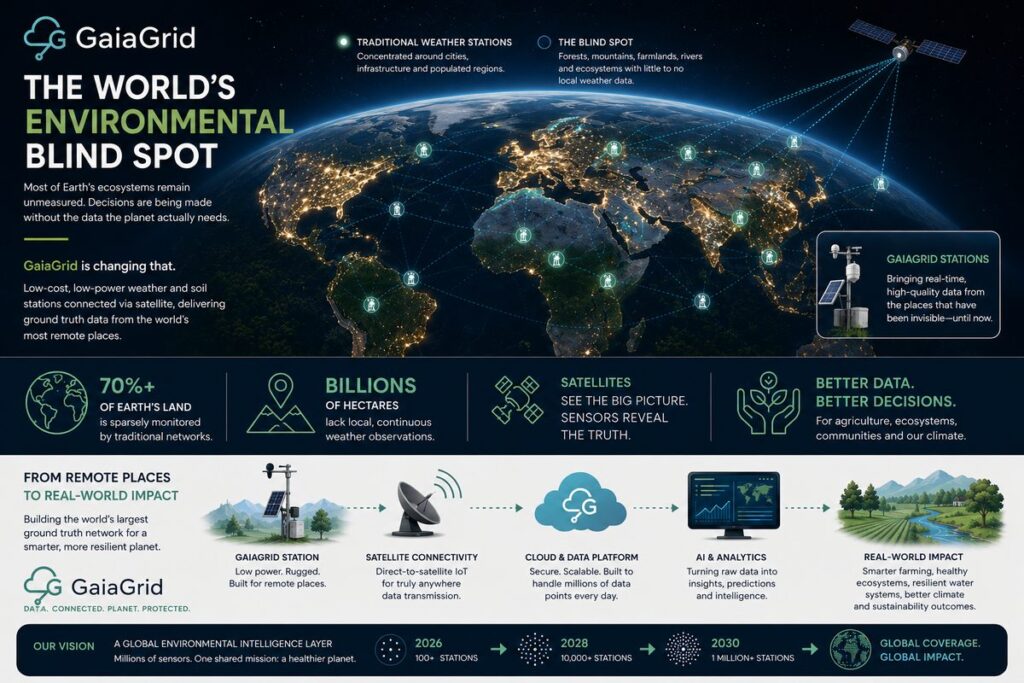
Earth observation (EO) satellites can tell us a great deal. It can measure vegetation health, estimate soil moisture, monitor rainfall patterns and detect changes in land use. But satellites are only part of the picture. To understand what is really happening on the ground, satellite observations need validation from real-world measurements.
The environmental sector refers to this as ground truth data.
Without ground truth, even the best Earth Observation systems are partly guessing.
This challenge becomes increasingly important as governments, researchers and businesses attempt to understand climate change, biodiversity loss, food production and water security. The decisions being made today increasingly depend on environmental data, yet the underlying measurement networks remain surprisingly sparse in many parts of the world. Existing weather station networks were largely designed for aviation, forecasting and population centres rather than environmental monitoring at landscape scale.
The result is a global blind spot.
Imagine a remote valley in Kenya. A hillside coffee plantation in Colombia. A reforestation project in Brazil. A river catchment in Poland. A food forest in Kerala.
These locations may be environmentally significant, economically valuable and ecologically sensitive. Yet many have little or no continuous weather data being collected on site.
This is where a new generation of environmental sensing becomes possible.
Recent advances in low-power electronics, sensor technology and satellite IoT connectivity mean weather stations no longer need mains electricity, cellular coverage or expensive infrastructure. A weather station can now operate for years on a small solar panel and battery while transmitting data directly through satellite networks from virtually anywhere on Earth.
Suddenly, locations that were once impossible to monitor become practical.
The implications extend far beyond weather forecasting.
Agriculture can benefit from highly localised climate data that improves irrigation planning, disease prediction and crop management. Environmental organisations can monitor ecosystem health over long periods. Researchers can study microclimates that have never previously been measured. Carbon projects can build stronger evidence bases. Water managers can better understand catchments and rainfall variability.
Each weather station becomes more than a sensor.
It becomes a node in a global environmental intelligence network.
As these networks expand, something even more valuable emerges. Individual measurements become collective knowledge. One weather station is useful. One thousand stations reveal regional patterns. One million stations begin to uncover how local environments interact with global climate systems.
This vision is at the heart of GaiaGrid.
The ambition is not simply to deploy weather stations.
The ambition is to help create a new environmental data layer for the planet.
A layer built from real observations, collected continuously, from places that have historically been invisible to traditional monitoring systems.
Satellites will continue to play a crucial role in understanding Earth. In many ways they provide humanity’s greatest environmental observatory. But the future will not belong to satellites alone. It will belong to the combination of satellite observation and ground truth.
Space looking down. Sensors looking up.
Together creating a richer, more accurate understanding of the living systems that sustain us. The world does not need a few more weather stations. It needs millions.